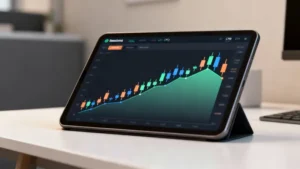
Embarking on your trading journey can feel like learning a new language, and at the heart of it is mastering the CFD trading platform. This central hub is where all your analysis, execution, and monitoring will take place. For beginners, the array of charts, buttons, and numbers can be overwhelming. This ultimate guide is designed to demystify the process, providing a step-by-step playbook on how to use a CFD platform effectively. We will break down everything from the basic interface to the more complex concepts of margin and leverage, equipping you with the knowledge to trade with greater confidence.
Mastering the CFD Trading Platform: What is a CFD Trading Platform and How Does It Work?
A CFD (Contract for Difference) trading platform is a software program provided by a broker that acts as your gateway to the financial markets. It allows you to speculate on the price movements of various assets—such as stocks, forex, commodities, and indices—without actually owning the underlying asset. Think of it as your digital trading desk. When you open a position, you are entering into a contract with your broker to exchange the difference in the asset’s price from the point the contract is opened to when it is closed. The platform provides real-time price feeds, charting tools, and account management features to facilitate these transactions.
Key Terminology for Beginners: CFDs, Spreads, and Pips
To navigate the platform confidently, you must understand its language. Here are the foundational terms:
- Contract for Difference (CFD): As mentioned, this is an agreement between you and a broker to exchange the difference in the value of a financial product between the time the contract opens and closes.
- Spread: This is the difference between the ‘buy’ (ask) price and the ‘sell’ (bid) price of an asset. It is the primary cost of a CFD trade. The tighter the spread, the less the price needs to move in your favour before you start making a profit.
- Pip (Percentage in Point): A pip is the smallest price move that an asset can make. For most currency pairs, one pip is equal to 0.0001. Understanding pips is crucial for calculating potential profit or loss.
Navigating the Core Interface: Dashboard, Watchlist, and Asset Selection
When you first log in, most platforms will present you with a standard layout:
- Dashboard/Account Summary: This provides a snapshot of your account, including your balance, equity (balance plus or minus any floating profits/losses), margin used, and available margin.
- Watchlist: This is a customisable list of financial instruments you want to monitor. You can add your favourite assets, like EUR/USD, Gold, or Tesla stock, to see their real-time bid/ask prices at a glance.
- Asset Selection: This window allows you to browse the full range of tradable assets offered by the broker. They are usually categorised (e.g., Forex, Indices, Crypto) to make searching easier.
Mastering the CFD Trading Platform: Essential Features You Must Master on Any CFD Platform
Beyond the basics, true mastery comes from using the platform’s analytical and risk management tools. These features transform it from a simple execution tool into a powerful trading assistant.
Understanding Charting Tools and Technical Indicators
The chart is the heart of the trading platform. It visually represents an asset’s price history. Mastering charting involves:
- Candlestick Charts: Learn to read candlestick patterns, which show the open, high, low, and close prices for a specific period. They provide much more information than a simple line chart.
- Timeframes: You can view price action on different timeframes, from one minute to one month. Shorter timeframes are for day traders, while longer ones are used by swing or position traders.
- Technical Indicators: These are mathematical calculations based on price and/or volume. Platforms like Ultima Markets MT5 offer dozens of indicators. Beginners should start with a few key ones like:
- Moving Averages (MA): To identify the direction of the trend.
- Relative Strength Index (RSI): To identify overbought or oversold conditions.
- MACD (Moving Average Convergence Divergence): To gauge momentum.
Placing Your First Trade: A Guide to Order Types (Market, Limit, Stop)
Executing a trade is more than just clicking ‘buy’ or ‘sell’. Understanding order types gives you precise control over your entries. To get a foundational understanding, you can review this Beginner’s Tutorial.
| Order Type | Description | Best Used When… |
|---|---|---|
| Market Order | An instruction to buy or sell immediately at the best available current price. | You want to enter the market quickly and are certain about the trade direction now. |
| Limit Order | An instruction to buy or sell at a specific price or better. A buy limit is set below the current price; a sell limit is set above. | You believe the price will reverse after hitting a certain level and want to enter at a more favourable price. |
| Stop Order | An instruction to buy or sell once the price reaches a specific, less favourable point. A buy stop is set above the current price; a sell stop is set below. | You want to trade a breakout, entering the market as it gains momentum in a particular direction. |
Setting Up Take Profit and Stop Loss Orders to Manage Risk
These are arguably the most important orders for any trader. They are pre-set instructions to automatically close your trade, protecting your capital and locking in profits.
- Stop Loss (SL): This order closes your trade if the market moves against you by a specified amount. It is your primary defence against significant losses.
- Take Profit (TP): This order closes your trade when it reaches a certain level of profit. It helps you exit a winning trade before a potential market reversal erases your gains.
Example: You buy EUR/USD at 1.0750. You could set a Stop Loss at 1.0720 (risking 30 pips) and a Take Profit at 1.0810 (aiming for 60 pips profit). The platform will automatically manage the exit, whether you are watching or not.
Mastering the CFD Trading Platform: How to Use Margin and Leverage in CFD Accounts Effectively
Margin and leverage are powerful tools unique to derivatives trading like CFDs. However, they are often misunderstood by beginners and are the primary reason traders can lose money quickly. Understanding them is non-negotiable for safe trading.
What Is Margin and How Is It Calculated?
Margin is not a fee; it is a portion of your account equity set aside as a good faith deposit to open and maintain a leveraged position. The amount of margin required depends on the leverage offered by your broker.
Calculation: Margin Required = (Total Position Size) / Leverage Ratio
For example, to open a £100,000 position with 30:1 leverage, the margin required would be £100,000 / 30 = £3,333.33.
Understanding Leverage: The Pros and Cons
Leverage allows you to control a large position with a small amount of capital (the margin). It magnifies your exposure to the market. This is a double-edged sword: it amplifies potential profits but also potential losses.
| Aspect | Pros (The Upside) | Cons (The Downside) |
|---|---|---|
| Capital Efficiency | You can open larger positions than your account balance would normally allow. | It encourages over-trading or taking on excessively large positions. |
| Profit Magnification | Small, favourable price movements can result in substantial profits relative to your margin. | Small, adverse price movements can result in substantial losses, potentially wiping out your account. |
| Market Access | Provides access to markets that might otherwise require significant capital. | Can create a false sense of security about the capital required to trade safely. |
How to Avoid a Margin Call and Protect Your Capital
A ‘margin call’ occurs when your account equity falls below the required margin to keep your positions open. The broker may then automatically close some or all of your positions at a loss. To avoid this:
- Use Stop Losses: This is your first line of defence. Always trade with a stop loss.
- Don’t Over-leverage: Just because your broker offers 30:1 leverage doesn’t mean you have to use it all. Use lower leverage, especially when you are starting.
- Monitor Your Margin Level: Your platform will show a ‘margin level’ percentage. If it drops close to 100%, you are in the danger zone.
- Keep Sufficient Free Margin: Don’t commit all your capital to margin. Having a buffer of free margin allows your trades to withstand normal market fluctuations.
Recommended Reading
To further enhance your trading knowledge, explore our detailed guide on CFD Trading Tips and Strategies, which covers advanced techniques for market analysis and execution.
Mastering the CFD Trading Platform: Basic Trading Strategies to Implement on Your Platform
With an understanding of the tools, you can begin to implement simple strategies. The goal is not to find a ‘holy grail’ but to develop a consistent approach to the markets.
Developing a Simple Trend-Following Strategy
Trend-following is one of the most popular strategies for beginners. The concept is simple: identify the direction of the market trend and trade in that direction. You can use the platform’s tools to do this:
- Identify the Trend: Add a 50-period and a 200-period Moving Average to your daily chart. If the 50 MA is above the 200 MA, the asset is in a general uptrend. If it’s below, it’s in a downtrend.
- Find an Entry: In an uptrend, look for pullbacks (dips) towards the 50 MA as a potential buying opportunity. In a downtrend, look for rallies towards the 50 MA to sell.
- Set Your Exits: Place your stop loss below the recent swing low for a buy trade, or above the recent swing high for a sell trade. Set your take profit at a level that gives you at least a 1:1.5 risk-to-reward ratio.
Using the Platform’s Tools for News Trading
Major economic news releases can cause significant market volatility. Many platforms have a built-in economic calendar. Here’s a basic approach to news trading:
- Check the Calendar: Look for high-impact events for the currencies or markets you are trading (e.g., Non-Farm Payrolls for USD, interest rate decisions).
- Stay Out Before the Release: The moments just before a big announcement are unpredictable. It’s often wiser to wait for the data to be released.
- Trade the Reaction: Wait for the initial spike to settle and for a clear direction to emerge in the first 5-15 minutes. You can then trade in the direction of that initial, strong momentum, using a tight stop loss.
Mastering the CFD Trading Platform: Choosing the Right CFD Trading Platform for Your Needs
Not all platforms are created equal. The right choice depends on your trading style, experience level, and needs. A platform’s reputation and reviews can be a telling factor.
Key Factors to Compare: Fees, Regulation, and Available Assets
| Factor | What to Look For |
|---|---|
| Regulation & Fund Safety | Is the broker regulated by a top-tier authority (e.g., FCA in the UK, ASIC in Australia)? Do they offer segregated client accounts? Check their policy on fund safety. |
| Fees & Spreads | Look for competitive and transparent spreads. Check for other fees like commissions, overnight financing (swap fees), and inactivity fees. The deposits & withdrawals process should also be clear. |
| Platform & Tools | Is the platform stable and user-friendly (e.g., MT4, MT5, or a proprietary web trader)? Does it have the charting tools and indicators you need? Is there a mobile app? |
| Asset Availability | Does the broker offer the markets you want to trade? (e.g., specific stocks, exotic currency pairs, or a wide range of commodities). |
| Customer Support | Is support available when you need it (ideally 24/5)? Do they offer multiple contact methods (live chat, phone, email)? |
Why Using a Demo Account is a Crucial First Step
Before committing real money, you must spend time on a demo account. This is a simulated trading environment with virtual funds that mirrors the live market. It is the perfect place to:
- Familiarise yourself with the platform’s layout and features.
- Practise placing different order types.
- Test your trading strategies without financial risk.
- Understand the real-world effects of leverage and margin.
Consider opening a demo account with a reputable provider like Ultima Markets to apply what you’ve learned in a risk-free setting.
Mastering the CFD Trading Platform: Conclusion
Mastering the CFD trading platform is a journey, not a destination. It begins with understanding the core interface and terminology, progresses to utilising charting and order tools, and culminates in the disciplined application of strategy and risk management. The platform is your most important tool; by investing time in learning its intricacies on a demo account, you build a strong foundation for live trading. Remember that successful trading is less about having a complex platform and more about using its features consistently and responsibly to execute a well-defined plan.
Mastering the CFD Trading Platform: FAQ
1. What is the best CFD trading platform for a beginner?
The best platform for a beginner is one that is user-friendly, well-regulated, and offers a comprehensive demo account. MetaTrader 4 (MT4) and MetaTrader 5 (MT5) are industry standards renowned for their intuitive design and extensive analytical tools, making them excellent choices for new traders.
2. Can you lose more than your initial deposit when trading CFDs?
This depends on the broker’s policy and regulation. In Europe and the UK, brokers regulated by authorities like ESMA and the FCA are required to provide ‘negative balance protection’. This ensures you cannot lose more than the total funds in your trading account. Always confirm this feature with your broker.
3. What’s the minimum amount needed to start CFD trading?
Many brokers allow you to open an account with as little as $100. However, starting with such a small amount can be risky due to leverage. A more practical starting capital would be around $500 to $1,000, which allows for more flexible position sizing and better risk management.
4. How do CFD platforms make money?
CFD brokers primarily make money through the ‘spread’ – the small difference between the buy and sell price of an asset. Some may also charge a commission on certain trades (like share CFDs) and overnight financing fees (swaps) for positions held open overnight.
*This article is for informational purposes only and does not constitute financial advice. The content reflects the author’s personal opinions. Trading CFDs involves significant risk and may not be suitable for all investors. You could lose all of your invested capital.