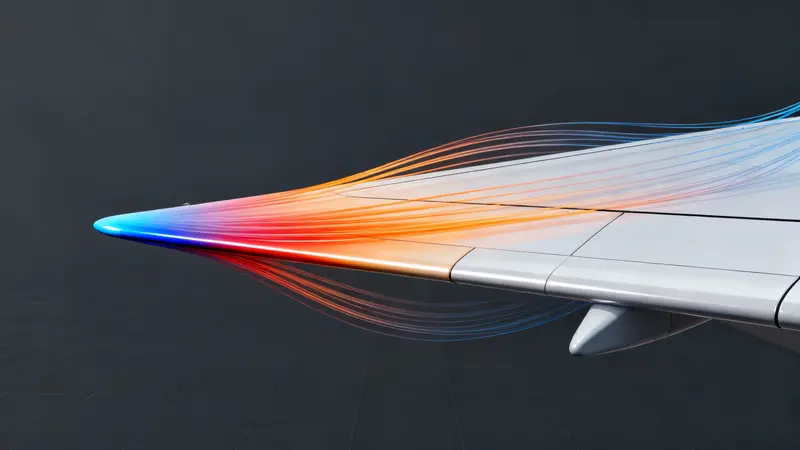
In the world of modern engineering, designing and testing innovative products requires precision, efficiency, and foresight. This is where CFD analysis comes in. As a cornerstone of digital engineering, Computational Fluid Dynamics (CFD) simulation allows engineers to predict fluid flow, heat transfer, and chemical reactions with incredible accuracy before a single physical prototype is built. By harnessing the power of sophisticated CFD software, designers can visualise the invisible, optimise performance, and solve complex challenges across countless industries. This guide provides a comprehensive overview of what computational fluid dynamics is and how it is revolutionising the engineering landscape.
Recommended Reading
What is Computational Fluid Dynamics (CFD)? A Look at This Engineering Simulation Tool
Computational Fluid Dynamics (CFD) is a branch of fluid mechanics that uses numerical analysis and data structures to analyse and solve problems that involve fluid flows. In essence, it’s the science of predicting what will happen when fluids (like air or water) flow past or through objects. Using computers, CFD creates simulations that can model everything from the airflow over an airplane wing to the blood flowing through an artery.
◆Core Principles: The Navier-Stokes Equations
At the heart of every CFD simulation are the Navier-Stokes equations. Think of these as the ‘rules of the road’ for fluid motion, derived from Newton’s second law of motion. These complex, non-linear partial differential equations describe how the velocity, pressure, temperature, and density of a moving fluid are related. Solving them directly is incredibly difficult, which is why we rely on powerful computers to approximate the solutions numerically. The process is similar to how complex financial models are built using algorithmic trading principles to predict market movements based on a set of core rules.
◆Why CFD Analysis is Crucial in Modern Engineering
The value of CFD lies in its ability to provide detailed insights that are often too expensive, dangerous, or impossible to obtain through physical testing. It allows engineers to:
- Visualise Flow Patterns: Understand complex, three-dimensional flow behaviours inside or around a design.
- Optimise Designs: Test multiple design variations quickly and cheaply to improve efficiency, reduce drag, or enhance heat transfer.
- Predict Performance: Accurately forecast the performance of a product under a wide range of operating conditions.
- Enhance Safety: Simulate hazardous scenarios, like fires in a building or wind loads on a bridge, without any real-world risk.
◆CFD vs. Physical Prototyping: Pros and Cons
While physical testing remains important, CFD offers a compelling digital alternative. Here’s a comparison:
| Factor | CFD Analysis | Physical Prototyping |
|---|---|---|
| Cost | Lower, primarily software and computational costs. Easy to iterate. | High, involves material, manufacturing, and facility costs for each prototype. |
| Time | Faster. Simulations can run overnight, allowing for rapid design cycles. | Slower. Requires time for manufacturing, setup, and testing. |
| Data Richness | Extremely detailed. Provides data for every point in the flow field. | Limited to where sensors can be placed. |
| Flexibility | High. Easy to change parameters and test extreme conditions. | Low. Modifications can be difficult and costly. |
| Accuracy | Highly accurate but depends on the quality of the model and inputs. Requires validation. | Represents the real world but can have measurement errors. |
How a CFD Simulation is Performed: A Step-by-Step Process
Performing a CFD analysis is a systematic process that can be broken down into three main stages. Understanding these steps is key to appreciating how a digital model translates into actionable engineering insights.
▶Step 1: Pre-Processing (Geometry and Meshing)
This is the foundational stage where the problem is defined for the computer. It involves two key actions:
- Geometry Creation: The engineer first creates a 2D or 3D model of the object and the surrounding fluid domain using CAD (Computer-Aided Design) software. This is the digital blueprint.
- Meshing: The geometry is then divided into thousands or millions of small cells, collectively known as the mesh or grid. This is a critical step, as the quality of the mesh directly impacts the accuracy of the results. It’s like creating a high-resolution pixel grid over a digital image—the finer the grid, the more detail you can capture.
▶Step 2: Solving (Setting Up the Physics and Computation)
Once the mesh is ready, the engineer sets up the simulation in the CFD software. This is where the physics of the problem are defined:
- Physics Setup: Define fluid properties (e.g., air, water), flow conditions (e.g., speed, pressure), and boundary conditions (inlets, outlets, walls).
- Computation: The CFD solver then iteratively solves the Navier-Stokes equations for each cell in the mesh. This is a computationally intensive process that can take hours or even days on high-performance computers. The solver calculates values like velocity and pressure for every single cell until the solution converges to a stable state. This computational rigour is essential for reliable results, much like how traders rely on robust platforms like Ultima Markets MT5 for executing complex trading strategies.
▶Step 3: Post-Processing (Visualization and Data Analysis)
The raw output from the solver is a massive dataset of numbers. The post-processing stage is where this data is transformed into meaningful insights. Engineers use visualisation tools to generate:
- Contour Plots: Colourful maps showing the distribution of pressure, velocity, or temperature.
- Vector Plots: Arrows indicating the direction and magnitude of the flow at various points.
- Streamlines: Lines that show the path fluid particles would take.
This is the stage of technical analysis where engineers interpret the results, validate the simulation against known data, and make informed decisions about their design.
Key Applications of CFD Software Across Industries
CFD analysis is not limited to a single field; its applications are vast and continue to grow. Here are a few examples of how different industries leverage this powerful tool.
✈️Aerospace and Defense: Aerodynamics and Propulsion
This is the classical application of CFD. It’s used to design and analyse everything from commercial aircraft to fighter jets and spacecraft. Engineers simulate airflow over wings to calculate lift and drag, optimise engine combustion for efficiency, and study the extreme heat generated during atmospheric re-entry.
🚗Automotive: Vehicle Aerodynamics and Thermal Management
In the automotive industry, CFD is crucial for designing fuel-efficient and stable vehicles. Simulations help reduce aerodynamic drag, minimise wind noise, and manage the airflow through the engine bay to ensure effective cooling. For electric vehicles, it is essential for managing battery temperatures.
🏗️Civil Engineering: Wind Loading on Structures
CFD helps civil engineers understand the impact of wind on buildings, bridges, and other large structures. These simulations ensure structural integrity and pedestrian comfort by predicting wind pressures and flow patterns around buildings, preventing issues like vortex shedding on bridges.
⚡Energy Sector: Turbine Design and Cooling Systems
In the energy sector, CFD is used to optimise the design of wind turbines, gas turbines, and hydroelectric turbines to maximise energy extraction. It’s also used to design cooling systems for nuclear reactors and power plants, ensuring safe and efficient operation. This focus on security and efficiency is paramount, and it’s a principle shared by leading financial platforms that prioritize fund safety for their clients.
Further Insights
For those interested in the computational tools behind modern analysis, exploring the differences between trading platforms can be enlightening. Read our guide on How to Choose Between MT4 vs MT5 to understand how different software solutions cater to specific analytical needs.
Popular CFD Software and Tools You Should Know
The market for CFD software is diverse, with options ranging from comprehensive commercial packages to powerful open-source tools. Choosing the right one depends on your specific needs, budget, and expertise.
■Commercial Solvers: Ansys Fluent & Autodesk CFD
These are industry-leading software suites known for their user-friendly interfaces, extensive validation, and dedicated customer support.
Ansys Fluent is renowned for its accuracy and broad range of physics models, making it a favourite in aerospace and automotive industries.
Autodesk CFD is well-integrated with CAD software, making it an excellent choice for product designers and engineers focused on electronics cooling and thermal analysis.
■Open-Source Options: OpenFOAM
OpenFOAM (Open Field Operation and Manipulation) is a powerful, free, and open-source CFD software. It offers immense flexibility and can be customised to solve complex, niche problems. However, it lacks a graphical user interface and requires a steeper learning curve, often involving command-line operations.
■Choosing the Right CFD Software for Your Needs
Here’s a quick comparison to help you decide:
| Software | Best For | Pros | Cons |
|---|---|---|---|
| Ansys Fluent | High-fidelity, complex simulations | Highly accurate, versatile, great support | Very expensive |
| Autodesk CFD | Design engineers, CAD integration | User-friendly, seamless workflow | Less suitable for very complex physics |
| OpenFOAM | Academia, R&D, custom solvers | Free, highly customisable, powerful | Steep learning curve, no official support |
Conclusion
Computational Fluid Dynamics analysis has firmly established itself as an indispensable tool in the engineer’s arsenal. By bridging the gap between theoretical physics and real-world application, CFD provides unparalleled insight into fluid dynamics problems. It enables the creation of more efficient, safer, and innovative products at a reduced cost and faster pace than ever before. Whether you are designing the next supersonic aircraft or a more efficient data centre cooling system, understanding and leveraging CFD analysis is no longer an option, but a necessity for staying at the forefront of engineering excellence.
FAQ
1. What are the main limitations of CFD analysis?
The primary limitations are its dependence on the accuracy of the initial model and assumptions. A poorly constructed mesh or incorrect boundary conditions will lead to inaccurate results (‘garbage in, garbage out’). Furthermore, CFD requires significant computational resources, and complex simulations can be time-consuming. Finally, all simulations must be validated against experimental data to be fully trusted.
2. What is the difference between CFD and FEA?
CFD (Computational Fluid Dynamics) and FEA (Finite Element Analysis) are both simulation methods, but they apply to different domains. CFD is used to analyse fluid flow, heat transfer, and related phenomena. FEA, on the other hand, is used for structural analysis to understand how solid objects behave under stress, vibration, or heat.
3. How accurate is CFD simulation?
When performed correctly by an experienced user, CFD can be extremely accurate, often within 5-10% of experimental results. The accuracy depends heavily on the quality of the mesh, the appropriateness of the physics models chosen, and the available computational power. For many engineering applications, this level of accuracy is more than sufficient for design and analysis.
4. Is CFD difficult to learn?
Learning CFD requires a solid understanding of fluid mechanics and numerical methods. While modern commercial software with graphical user interfaces has made it more accessible, becoming a proficient CFD analyst takes time and practice. Open-source tools like OpenFOAM have a steeper learning curve due to their reliance on command-line interfaces.
*The content of this article represents the author’s personal views only and is for reference purposes. It does not constitute any professional advice.