

As we enter 2026, the market’s dominant narrative has shifted decisively. The bearish recession thesis has faded, replaced by expectations of growth normalization—a transition that is fundamentally supportive for risk assets. In this environment, the NASDAQ 100 is well-positioned to outperform, sitting at the intersection of three powerful macro forces: monetary easing, AI monetization, and U.S. economic exceptionalism.
Barring the emergence of a sudden and deep recession—an outcome current data does not support—the path of least resistance for U.S. technology equities remains higher.
1. The Fed Path: “Insurance Cuts” Fuel the Multiple
The Core Thesis: You do not need aggressive rate cuts to spark a rally; you only need the absence of tight monetary conditions.
After the cuts implemented in late 2025, the Federal Reserve has shifted into a fine-tuning phase. Consensus expectations for 2026 point to 50–75 basis points of additional easing (two to three incremental cuts), bringing policy rates closer to a neutral range of approximately 3.0%–3.25%.
Why does this support the NASDAQ? The answer is straightforward: technology stocks are long-duration assets. As the risk-free rate trends lower, the present value of future cash flows increases mechanically.
Importantly, these cuts are not panic responses to economic stress. They are “maintenance” or insurance cuts, designed to support a soft landing. Historically, equities tend to rally most strongly when the Fed eases while the economy is still expanding (e.g. 1995, 2019). This represents a classic Goldilocks scenario for risk assets.
2. Tech Resilience: The “AI ROI” Phase
The Core Thesis: The 2024–2025 cycle was about spending on chips (Nvidia); the 2026 cycle is about monetizing software.
Arguments for an impending tech slowdown overlook this critical transition. The massive CapEx deployed over the past two years is now coming online as high-margin, recurring revenue.
- Companies such as Microsoft, Adobe, and Salesforce are rolling out agentic AI features that directly lift productivity and increase average revenue per user (ARPU).
- Even in a moderating growth environment, NASDAQ 100 heavyweights hold vast cash reserves and generate strong free cash flow. They increasingly resemble “yield-bearing growth utilities”, capable of compounding earnings at ~15%+.
In a world of slowing growth, capital gravitates toward companies that control their own earnings destiny — and that remains firmly in the domain of Big Tech.
3. Long-Term Trajectory: The “US Exceptionalism” Premium
The Core Thesis: Betting against U.S. equities has been a losing strategy for decades, and the valuation gap versus the rest of the world continues to widen.
The market is approaching an AI-driven productivity shock, comparable in magnitude to the late-1990s internet boom. This dynamic raises the long-term GDP ceiling without necessarily reigniting inflation pressures.
From a global allocation perspective, alternatives remain limited. Europe continues to face structural stagnation, while China remains difficult to allocate to for many institutions. The U.S. market remains the deepest, most liquid, and most innovation-driven capital market globally, supporting a durable valuation premium over the coming decade.
4. Key Risk: The “Hard Landing” (Low Probability)
While the outlook remains constructive, there are still caveats. The bullish case is anchored to the soft-landing narrative.
If labor market cooling accelerates into widespread layoffs — pushing unemployment above 5.5% — consumer spending would weaken materially. In that scenario, technology earnings would contract, and the NASDAQ could experience a meaningful corrective move.
At present, this risk appears contained. Corporate balance sheets remain healthy, and the Federal Reserve retains ample policy flexibility. The “Fed put” remains intact.
Overall, we expect the NASDAQ to remain volatile in Q1 2026, but with an upward bias. Pullbacks not driven by recession fears should continue to offer position-building or tactical long opportunities.
5. Trading Insights: NAS100 (Nasdaq 100 Index)
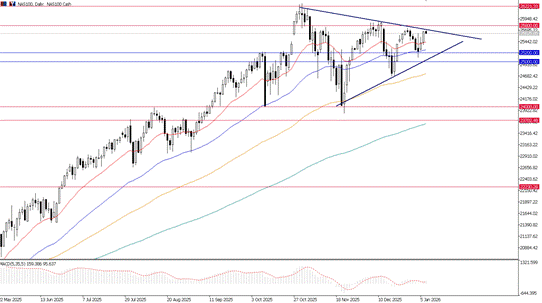
The daily chart shows a classic symmetrical triangle consolidation forming near all-time highs. This is not a reversal pattern, but a continuation structure. The market has paused to allow moving averages to catch up, effectively “coiling” energy for the next directional move.
The key signal is volatility compression: shrinking candle ranges typically precede volatility expansion. Given the Fed easing backdrop into 2026, the probability favors an upside resolution.
Trading Plan: The “Breakout & Hold”
The Strategy: Focus on a breakout long. Avoid positioning in the middle of the triangle (the choppy zone). Instead, buy strength or buy the floor.
Key Levels to Watch:
- 25,800: Short-term resistance. A daily close above this level confirms a bullish breakout.
- 26,250: All-time high. Primary upside target for bulls.
- 25,000: Major support zone offering buy-the-dip opportunities.
- 24,000: Structural support suitable for deeper corrective accumulation.
Ideally, a clean breakout above the 25,800 triangle resistance would open the door to another record-high extension. From a positioning perspective, 25,000 serves as a tactical dip-buy zone, while 24,000 represents a higher-conviction long-term accumulation level.
Risk to Watch: A sustained break below 24,000 would signal a short-term trend shift and warrant increased caution. Until then, the broader directional bias remains clear.
Summary: “The chart says ‘Pause,’ not ‘Stop.’”. The symmetrical triangle suggests the market is building energy for a potential move toward 28,000. Use consolidation near 25,000 as a buying floor, or wait for the 25,800 ceiling to break decisively before adding exposure aggressively.