

Are you truly making a profit from your investments, marketing campaigns, or business projects? In a world filled with complex financial metrics, it is easy to lose track of the most important question:is your money generating returns? Without a clear method of measurement, your financial decisions are based on guesswork, not strategy. That’s why Return on Investment (ROI) matters.
As a clear KPI, ROI shows profitability at a glance. This comprehensive guide will walk you through everything you need to know about ROI. We will cover its fundamental definition, the simple formula for its calculation, real-world examples, and advanced strategies for improving it—helping you make smarter, data-driven financial decisions for sustainable growth.
What is Return on Investment (ROI)?
Before delving into calculations and strategies, it is essential to grasp the core concept of Return on Investment. It is more than just a piece of financial jargon; it is a fundamental tool for assessing performance across a vast range of activities, from buying shares on the stock market to launching a new social media campaign.
A Clear Definition of ROI
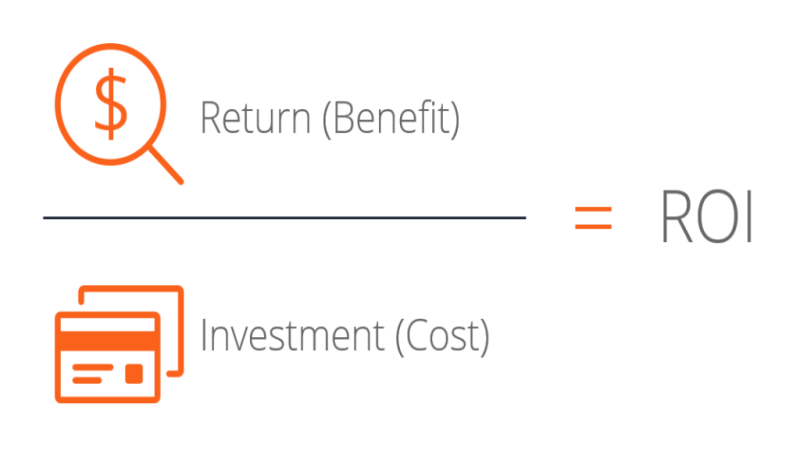
In simple, jargon-free terms, Return on Investment (ROI) is a performance measure used to evaluate the efficiency or profitability of an investment. It is typically expressed as a percentage or a ratio. The core concept is to measure the amount of financial return on a particular investment relative to that investment’s cost. A high ROI means the investment’s gains compare favourably to its cost. Conversely, a low or negative ROI indicates that the returns are meagre or that you have lost money.
Think of it like this: if you put $100 into a venture and get $120 back, your return is $20. The ROI tells you how efficient that $100 was at generating that profit. This simple principle allows you to compare vastly different types of investments on a like-for-like basis.
Why ROI is a Critical Metric for Success
The versatility of the ROI calculation is what makes it an indispensable tool for business owners, marketers, and individual investors alike. Its importance can be seen in several key areas:
- Justifying Spending and Allocating Budgets: Whether you are a marketing director proposing a new campaign or a department head needing new equipment, a projected ROI provides the concrete data needed to justify the expenditure. It shifts the conversation from cost to value creation.
- Comparing the Profitability of Multiple Investments: Should you invest in stocks, property, or expanding your business? Each has different costs and potential returns. ROI provides a standardised metric to compare these apples and oranges, helping you decide where your capital will work hardest.
- Evaluating the Performance of Past Decisions: ROI is not just for forecasting. It is a powerful tool for retrospective analysis. Calculating the actual ROI of a completed project helps you learn what worked, what did not, and how to improve future strategies.
- Making Informed Financial Forecasts: By analysing historical ROI data from various projects, a business can make more accurate predictions about the potential profitability of future initiatives, leading to more robust financial planning.
How to Calculate ROI: The Essential Formula
Calculating your Return on Investment is surprisingly straightforward. Its beauty lies in its simplicity, which allows for quick assessments and easy comparisons. Let us break down the formula and apply it to real-world scenarios.
The Basic ROI Formula
The standard formula for calculating ROI is presented as a percentage:
| ROI (%) = [(Net Profit / Cost of Investment)] x 100 |
To use this formula, you need to understand its two main components:
- Net Profit: This is the total earnings from the investment minus the initial cost. The formula is: Net Profit = Current Value of Investment – Cost of Investment.
- Cost of Investment: This is the total amount of money you put into the investment. It is crucial to be comprehensive here and include all associated costs (e.g., purchase price, fees, taxes, maintenance).
Practical Calculation Example: A Step-by-Step Walkthrough
Let us use a simple example of investing in shares to illustrate the ROI calculation.
- Initial Investment: You buy shares in Company XYZ for a total cost of $1,000.
- Sale of Investment: A year later, you sell those shares for $1,250.
- Calculate Net Profit: Net Profit = $1,250 (Current Value) – $1,000 (Cost) = $250.
- Calculate ROI: ROI = ($250 / $1,000) x 100 = 25%.
Your Return on Investment for this transaction is 25%.
Calculating ROI in Forex and CFD Trading
The concept of Return on Investment is also fundamental in the world of financial trading, such as Forex and CFDs. However, the calculation can be more nuanced. The ‘Cost of Investment’ includes not just the capital risked on a trade but also associated trading costs like spreads, commissions, and overnight financing (swap fees). Furthermore, the use of leverage can amplify both gains and losses, dramatically affecting the final ROI percentage.
This is where modern trading platforms become invaluable. Reputable brokers like Ultima Markets provide traders with advanced platforms such as the Ultima Markets MT5. These platforms offer detailed account statements and analytics tools that automatically track your trading history, profits, and losses. This data is essential for performing an accurate ROI calculation, allowing traders to assess the performance of their strategies effectively.
What is a Good ROI? Setting Your Benchmarks
Once you have calculated your Return on Investment, the next logical question is: is it any good? Unfortunately, there is no single number that defines a ‘good’ ROI. The answer is highly dependent on the context of the investment.
The ‘It Depends’ Answer: Context is Everything
A good ROI varies dramatically based on factors such as the industry, the type of investment, and your personal risk tolerance. A 10% annual ROI from a relatively safe blue-chip stock portfolio might be considered excellent, whereas a 10% ROI from a high-risk tech start-up investment might be seen as disappointing given the level of risk involved. Context is paramount when evaluating your returns.

General ROI Benchmarks by Investment Type
To provide some perspective, here are some widely cited, general annual ROI benchmarks for different asset classes. These are long-term averages and can fluctuate significantly year to year.
| Investment Type | Typical Annual ROI Benchmark | Risk Level |
| Stock Market | 7-10% | Medium |
| Residential Property (Rental) | 5-10% (yield + appreciation) | Medium-High |
| Government Bonds | 2-5% | Low |
| Marketing Campaign | > 500% (5:1 Ratio) | Varies |
Factors That Influence Your Expected ROI
- Risk: The fundamental principle of investing is the risk-return trade-off. Higher potential returns almost always come with higher risk. Therefore, a good ROI must be assessed against the risk taken to achieve it.
- Time Horizon: How long are you prepared to have your capital tied up in the investment? Some investments, like property, may deliver a strong ROI over a decade, but a poor one if you are forced to sell in a year.
- Economic Conditions: Inflation, interest rates, and overall economic growth can significantly impact your Return on Investment. For example, in a high-inflation environment, an ROI of 5% may actually be a net loss in real terms.
How to Improve and Maximise Your ROI
Improving your Return on Investment is the ultimate goal of any financial endeavour. Looking at the ROI formula, there are two primary levers you can pull: increasing your net profit or decreasing your investment cost. Let us explore actionable strategies for both.
Strategy 1: Increase Your Net Profit
This involves maximising the revenue generated from your initial investment. For a business, this could mean optimising pricing strategies, upselling or cross-selling to existing customers, or improving operational efficiency to produce more with the same resources. For an investor, it could involve rebalancing a portfolio towards higher-growth assets or actively managing rental properties to maximise occupancy and rental income.
Strategy 2: Reduce Your Costs
Minimising the ‘Cost of Investment’ directly boosts your ROI percentage. Businesses can achieve this by negotiating better terms with suppliers, reducing overheads, or adopting more efficient technology. For traders and investors, this is particularly crucial. Choosing a broker with competitive spreads, low commissions, and efficient payment systems can significantly impact overall profitability. Reviewing options for deposits & withdrawals to minimise transaction fees is a practical way to reduce costs and enhance your net Return on Investment.
Strategy 3: Optimise the Investment Period
While not part of the basic formula, the time it takes to generate a return is a critical factor. A 20% ROI achieved in one year is far superior to a 20% ROI achieved over five years. Focusing on strategies that accelerate returns can have a massive impact on your capital’s efficiency. This introduces the concept of ‘Annualised ROI’, which provides a more accurate year-on-year comparison for investments held for different periods.
The Limitations of ROI You Must Understand
While Return on Investment is a powerful metric, it is not perfect. A sophisticated investor or business leader understands its limitations and uses it in conjunction with other metrics for a more holistic view. Being aware of these drawbacks helps prevent misleading conclusions and ensures responsible decision-making, which is why reading third-party reviews and ensuring measures like fund safety are in place is always a wise step before any investment.

ROI Doesn’t Consider the Time Factor
As mentioned, the basic ROI formula does not account for the length of the investment period. This is its single biggest limitation. To solve this, you can use the Annualised ROI formula: Annualised ROI = [(1 + ROI)^(1/n) – 1] x 100, where ‘n’ is the number of years the investment is held. This allows for a fair comparison of investments with different time horizons.
ROI Can Be Manipulated
The ROI figure can be skewed, intentionally or unintentionally, by how ‘cost’ and ‘return’ are defined. For example, if a marketing campaign’s ROI calculation includes advertising spend but excludes the salaries of the marketing team that ran it, the resulting figure will be artificially inflated. Consistency in calculation methods is key to achieving meaningful results.
ROI Ignores Non-Financial Benefits and Risks
Return on Investment is purely a financial metric. It cannot measure intangible benefits like increased brand awareness, improved customer satisfaction, or enhanced employee morale. Similarly, it does not inherently account for the level of risk undertaken. Two investments might have the same 15% ROI, but one might be a stable property investment while the other is a highly volatile cryptocurrency. For this reason, ROI should be considered alongside other metrics like Net Present Value (NPV), Payback Period, and risk assessment models.
Conclusion
In a complex financial landscape, Return on Investment (ROI) stands out as a fundamental, powerful, and universally applicable metric for evaluating profitability. It provides a clear, concise measure of how effectively your capital is being put to work. From deciding on a business expansion to choosing a personal investment, the ability to calculate and interpret ROI is essential.
However, mastery of this tool means understanding both its strengths and its limitations. By appreciating the importance of time, risk, and non-financial factors, you can use ROI as part of a more comprehensive analytical toolkit. Understanding how to accurately calculate and interpret your Return on Investment is not just an accounting task—it is a strategic necessity for anyone seeking sustainable financial growth and success. Start applying the ROI formula to your own projects and investments today to gain financial clarity and make more profitable decisions for your future.
FAQ
Q:What is the main difference between ROI and ROE (Return on Equity)?
ROI (Return on Investment) measures the return generated from the total cost of an investment (both debt and equity). ROE (Return on Equity) is more specific; it measures the rate of return on the money invested by shareholders (shareholder equity). ROI is a broader measure of an investment’s efficiency, while ROE is a measure of how effectively a company is using shareholder funds to generate profit.
Q:Can ROI be negative? What does it mean?
Yes, ROI can be negative. A negative ROI means that the total returns from an investment were less than the total costs. In simple terms, it means you have lost money. For example, if you invest $1,000 and the investment’s value drops to $800, your net profit is -$200, resulting in an ROI of -20%.
Q:How often should I calculate the ROI for my business?
The frequency of ROI calculation depends on the nature of the investment and the business cycle. For short-term projects or marketing campaigns, you might calculate it at the end of the campaign. For ongoing business operations, calculating ROI on a quarterly or annual basis is common practice. For long-term investments like property or stocks, an annual review of your ROI is generally sufficient.
Q:What is a good ROI for a digital marketing campaign?
A common benchmark for a good digital marketing ROI is a 5:1 ratio, which translates to a 500% ROI. This means for every $1 spent, you generate $5 in revenue. A ratio of 10:1 (1000% ROI) is considered exceptional. However, this can vary significantly by industry, channel (e.g., SEO vs. PPC), and campaign goals. It is important to also consider customer lifetime value (CLV) for a more accurate picture.
