

Swiss Franc Surges as Safe-Haven Demand Intensifies Amid Global Uncertainties
The Swiss Franc has strengthened dramatically in recent months, continuing a rally that saw the currency appreciate roughly 13-15% against the US Dollar throughout 2025. As of early 2026, the USD/CHF exchange rate has fallen below 0.8000, marking a significant shift in currency markets driven by escalating geopolitical tensions and concerns over US institutional stability.
Geopolitical Tensions Fuel Safe-Haven Flows
The CHF’s ascent has been propelled by mounting global uncertainties that have prompted investors to seek refuge in Switzerland’s historically stable currency. Recent geopolitical flashpoints have accelerated this trend.
In early January 2026, heightened tensions in the Middle East provided fresh impetus for CHF gains. President Trump’s warnings to Iran regarding the use of force against protesters, combined with Iranian cautions against potential US or Israeli intervention, created an atmosphere of uncertainty that benefited safe-haven assets.
More recently, on January 18, 2026, reports of weekend tariff threats from the Trump administration targeting Denmark’s Greenland territory triggered a 0.5% strengthening in the CHF. The situation intensified as several European Union nations reportedly began considering retaliatory tariffs on approximately $93 billion worth of US exports, raising fears of an expanding trade war.
US Political Instability Undermines Dollar’s Safe-Haven Status
Perhaps more troubling for the USD has been a series of domestic political developments that have called into question the stability of American institutions. On January 12, 2026, reports emerged that the Trump administration had threatened Federal Reserve Chair Jerome Powell with criminal indictment, sparking immediate market turbulence.
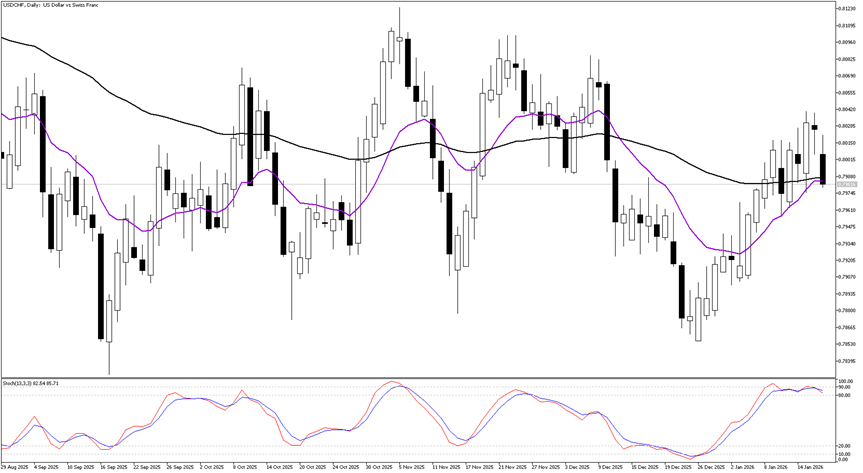
The threat against Powell raised serious concerns about Federal Reserve independence, a cornerstone of US monetary policy credibility. Markets responded with a swift USD selloff, while the CHF rallied approximately 0.6% as investors pivoted toward alternative safe-haven currencies. The Euro also gained as capital fled dollar-denominated assets.
This incident exemplified a broader trend that had been building throughout late 2025. By December 22, 2025, the USD had already reached a 14-year low against the CHF, foreshadowing the continued dollar weakness that would characterize early 2026.
Market Dynamics and Looking Ahead
The CHF’s strength has persisted even as US-Swiss yield differentials have widened in ways that would typically favor the dollar. This unusual dynamic underscores the extent to which markets are prioritizing capital preservation over yield in the current environment, viewing US fiscal concerns and inflation risks as outweighing traditional interest rate considerations.
While the Swiss National Bank maintains the option to intervene should CHF appreciation become excessive and threaten Swiss export competitiveness, the central bank has thus far allowed market forces to prevail. Economic forecasts project modest Swiss GDP growth of 1.1% for 2026, though analysts caution that continued safe-haven demand could amplify CHF gains if global risks escalate further.
The CHF’s upward trajectory appears likely to continue barring major resolutions to the geopolitical and political tensions currently roiling markets. For now, Switzerland’s currency remains the destination of choice for investors seeking stability in an increasingly uncertain world.
While the recent recovery has been strong, the USD/CHF is now facing heavy dynamic resistance from the long-term moving average, with oscillators showing overextended conditions. If the price fails to breach the black moving average and closes below the purple moving average (approximately 0.7970), this would signal a rejection of higher prices and likely trigger a move back down to 0.7930, where the strength of the recent recovery would be tested.
