
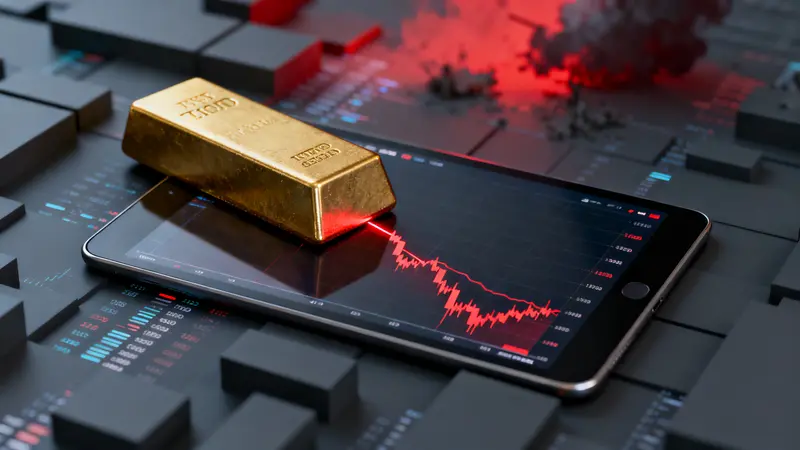
The question of why is gold falling during war has become a critical point of analysis for traders in 2026. Contrary to conventional wisdom, geopolitical conflict does not guarantee an immediate surge in gold prices. The initial market reaction often prioritizes liquidity and yield, channeling capital into the U.S. dollar and Treasury bonds.
As energy prices spike and inflation fears intensify, the complex interplay between monetary policy expectations and asset class competition reveals a more nuanced reality for bullion’s price action.
This guide delves into the core economic drivers, market mechanics, and strategic indicators that explain the current behavior of gold prices during conflict and what traders should be monitoring.
Table of Contents
The Short Answer: Why War Doesn’t Always Boost Gold Prices Immediately
In the initial phase of a major conflict, the market’s first instinct is often a flight to liquidity, not just to traditional safe havens. This means cash, particularly the U.S. dollar, becomes king. The immediate shock of war can trigger a broad-based deleveraging event, where investors sell liquid assets—including gold—to cover losses or margin calls in other parts of their portfolio.
Furthermore, if the conflict is perceived as an inflationary catalyst, primarily through energy price shocks, it can perversely work against gold in the short term. The market begins to price in a more aggressive stance from central banks, leading to higher bond yields and strengthening the dollar, both of which are significant headwinds for the non-yielding precious metal.
Key Economic Forces Hurting Gold More Than Geopolitics Are Helping
The core of the issue for why is gold falling during war in the current 2026 environment lies in a specific chain of economic transmission. It’s not that gold has lost its haven appeal entirely, but rather that other macroeconomic factors are exerting more powerful, immediate pressure on its price. Understanding this sequence is crucial for any trader navigating these volatile periods.
1. Rising Energy Prices Are Fueling Higher Inflation Fears
Geopolitical conflicts, especially in energy-producing regions, can cause a violent surge in crude oil prices. With Brent crude trading around $110.19 and WTI near $113.31, markets are not just reacting to the conflict itself but to the risk of stagflation. This sharp increase in energy costs feeds directly into headline inflation, creating a ripple effect across the economy.
As reported by Reuters on April 7, 2026, these energy-driven inflation fears are prompting traders to reprice assets sensitive to monetary policy, shifting the focus from geopolitical risk to inflation risk.
2. Persistent Inflation Is Pushing Back Interest Rate Cut Expectations
A direct consequence of heightened inflation anxiety is the recalibration of monetary policy expectations. When inflation runs hot, the probability of near-term interest rate cuts diminishes.
In fact, major financial institutions are adjusting their forecasts accordingly. Reports from early April 2026 indicated that both Wells Fargo Investment Institute and Citigroup have delayed their expectations for Federal Reserve rate cuts.
Wells Fargo now anticipates no cuts in 2026, while Citigroup has moved its forecast for the first cut to September. This hawkish shift is a significant headwind for gold, as higher rates for longer make holding a non-yielding asset less attractive.
3. Higher Bond Yields Increase the Opportunity Cost of Holding Gold
This is perhaps the most direct financial reason why is gold falling during war today. Gold pays no dividend or interest. Its value is derived from its scarcity and role as a store of value. When the yields on safe-haven government bonds rise, the opportunity cost of holding gold increases.
With the 10-year Treasury yield standing firm at 4.35% as of April 3, 2026, investors can earn a competitive, risk-free return in Treasuries. Critically, real yields (nominal yields minus inflation expectations) also remain elevated. High real yields are historically one of the strongest headwinds for gold, as they represent the true cost of forgoing interest-bearing assets.
Traders closely monitor data from sources like the St. Louis FRED database on 10-year real interest rates (series: REAINTRATREARAT10Y) to gauge this pressure.
Expert Insight: Real Yields as a Barometer for Gold
The inverse correlation between gold and real yields is a cornerstone of precious metals analysis. When real yields are negative, holding cash or bonds means losing purchasing power to inflation, making gold’s zero yield attractive.
Conversely, when real yields are positive and rising, as they have been in early 2026, the appeal of earning a real return on government debt often outweighs gold’s traditional hedging properties in the short to medium term. The upcoming March CPI release on April 10 is a pivotal data point that will directly influence real yield calculations and, by extension, gold’s trajectory.
4. The U.S. Dollar Is Winning the Initial Safe-Haven Bid
In times of acute global stress, the first wave of safe-haven demand invariably flows into the world’s most liquid currency: the U.S. dollar. The dollar’s status as the primary global reserve currency makes it the ultimate port in a storm. As the U.S. Dollar Index (DXY) remains supported near recent highs, it creates a dual headwind for gold.
Since gold is priced in dollars, a stronger dollar makes it more expensive for holders of other currencies, which can dampen international demand. This dynamic forces gold to fight against both rising yields and a strengthening dollar simultaneously.
Understanding Early-Stage Crisis Behavior: The Market-Wide Selloff
Beyond macroeconomic variables, the internal mechanics of the market also contribute to gold’s initial weakness during a conflict. These factors are less about fundamentals and more about the raw flow of capital under duress.
A Rush for Cash Means Investors Sell Their Most Liquid Assets
Gold’s high liquidity is a double-edged sword. While it makes it easy to buy and hold, it also makes it one of the first assets to be sold when portfolios need to raise cash quickly. In a broad risk-off event, where equity markets are plunging and volatility is spiking, institutional investors and hedge funds often face margin calls or a need to reduce overall exposure (deleveraging).
They sell what they *can*, not necessarily what they *want* to. As a highly liquid, often profitable position, gold becomes an easy source of funds, leading to selling pressure even as the safe-haven narrative strengthens.
Profitable Gold Positions Are Closed to Cover Margin Calls Elsewhere
This cross-asset deleveraging is a critical concept. If a fund has significant losses in stocks or other risk assets, it may be forced to sell its winners to maintain solvency or meet redemption requests. As MarketWatch has noted, recent drops in gold were tied not just to rates and the dollar, but also to hedge fund deleveraging.
This explains the paradoxical situation where the very reason to own gold (as a hedge) is overshadowed by the mechanical need to sell it to cover losses from the risks it was meant to hedge against.
Why This Dip Doesn’t Invalidate Gold’s Long-Term Haven Status
Even as traders grapple with why is gold falling during war, it is a profound mistake to extrapolate short-term, liquidity-driven price action into a permanent loss of strategic relevance. The long-term structural case for gold remains robust, supported by strong underlying demand from key players who operate on a different timeline than speculative traders.
Analyzing Long-Term Demand: Central Bank and ETF Holdings
Data from the World Gold Council (WGC) provides a powerful counter-narrative. In 2025, total gold demand reached a record 5,002 tonnes. This was driven by formidable institutional appetite: central banks bought a net 863 tonnes, and global gold-backed ETFs saw their second-strongest year on record with 801 tonnes of inflows.
This trend has continued into 2026, with central banks adding a net 19 tonnes in February and global gold ETFs recording their ninth straight month of inflows. This is not the behavior of an asset class losing its appeal; it is the profile of an asset being strategically accumulated on weakness by long-term holders focused on reserve diversification and wealth preservation. For more information, traders can check out our Gold CFD trading guide.
| Crisis Phase | Primary Market Driver | Impact on Gold | Dominant Assets |
|---|---|---|---|
| Phase 1: Liquidity Shock | Rush for cash, deleveraging | Negative to Neutral (can be sold as a source of funds) | U.S. Dollar, Short-Term Treasuries |
| Phase 2: Inflation/Rates Shock | Rising energy prices, hawkish monetary policy fears | Negative (rising real yields and strong USD) | Commodities (Oil), Inflation-Indexed Bonds |
| Phase 3: Growth Scare / Haven Realignment | Fears of economic slowdown, focus shifts to wealth preservation | Positive (yields fall, focus returns to gold’s store of value) | Gold, Long-Term Treasuries |
3 Signals That May Indicate the Gold Selloff is Temporary
For traders looking for actionable signals, identifying the end of this first phase of selling is key. Here are three indicators that could suggest the pressure on gold is abating.
- Price Stabilization Occurs Despite Worsening Geopolitical News: When an asset stops falling on bad news, it’s a strong sign that the negative factors have been fully priced in. If gold begins to find a floor or even rallies modestly while conflict headlines intensify, it suggests that the seller exhaustion point is near and the market’s focus is shifting.
- Real Yields Begin to Plateau or Decline: This is the most important macro trigger. If upcoming inflation data is softer than expected, or if growth concerns begin to outweigh inflation fears, bond yields may stop rising. A peak in real yields would remove the primary headwind for gold by reducing its opportunity cost.
- ETF Inflows Remain Positive or Accelerate on Price Weakness: Watch the daily and weekly ETF flow data closely. If strategic, long-term investors continue to add to their positions even as the spot price falls, it confirms that the ‘smart money’ views the selloff as a buying opportunity. This provides a strong underlying bid that can eventually overwhelm short-term speculative selling.
Key Market Events for Gold Traders to Watch This Week
To effectively trade this environment, generic commentary is insufficient. Traders must focus on the specific catalysts that can alter the current narrative. Here is a framework for the key events to monitor in the near term.
| Event / Variable | Why It Matters for Gold | What a Bullish Signal Would Look Like |
|---|---|---|
| March CPI Release (April 10) | Directly impacts inflation expectations and real yields. | A core inflation number that is softer than forecast. |
| Fed Minutes | Reveals policymakers’ balance between inflation and growth risks. | A tone that expresses more concern about economic slowdown. |
| 10-Year and Real Yields | The primary measure of gold’s opportunity cost. | Yields stabilizing and retreating from recent highs. |
| Energy Markets & Geopolitics | The transmission channel for the current inflation shock. | An easing of oil prices or de-escalation of conflict. |
Conclusion: A Trader’s Framework for Positioning
So, why is gold falling during war? The most accurate answer for 2026 is that the conflict is first being interpreted by the market as an inflation and rates shock, not a pure safe-haven event. The transmission mechanism runs from energy prices to inflation expectations, to delayed rate cuts, to higher real yields and a stronger U.S. dollar. This confluence of factors creates a challenging short-term environment for a non-yielding asset like gold.
However, this does not mean the safe-haven thesis is broken. It is simply being overshadowed by the immediate mechanics of a liquidity-driven and inflation-focused market. Strategic buyers like central banks continue to accumulate, signaling long-term confidence. For traders, the key is to differentiate between the initial shock and the potential second phase, where growth concerns could eventually cause yields to fall, allowing gold to reassert its traditional role. Monitor the data, respect the price action, and understand the sequence of market reactions.
Frequently Asked Questions (FAQ)
1. Is gold still a good hedge against inflation during a war?
Yes, over the long term, but not always in the short term. If war-driven inflation leads to higher real interest rates and tighter policy, gold can struggle even as prices rise elsewhere in the economy.
2. How does the U.S. dollar’s strength affect gold prices in a crisis?
A stronger U.S. dollar usually pressures gold. Because gold is priced in dollars, dollar strength makes it more expensive for global buyers and can reduce demand, especially in the early stage of a crisis when markets prioritize liquidity.
3. Do central bank buying patterns influence gold’s price during conflicts?
Yes. Central bank buying provides steady structural demand and can help support gold prices during periods of volatility. It also reinforces gold’s role as a long-term reserve asset even when short-term market flows are weak.
4. What is the historical performance of gold during major wars?
Gold’s performance during wars is mixed. Some conflicts have supported strong gold rallies, especially when inflation was high and real yields were low, while others saw investors move first into the U.S. dollar and Treasuries. War alone does not guarantee higher gold prices.
