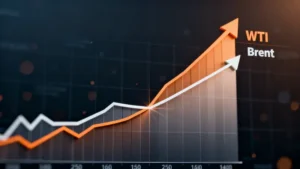
In the complex world of energy trading, the pricing hierarchy between crude oil benchmarks is typically stable. However, recent market dynamics have upended the norm, leaving many to ask: why is U.S. oil higher than Brent? The short answer is that U.S. oil is not usually priced above its European counterpart for long.
When this anomaly occurs, it’s a powerful signal that the market is desperately scrambling for the fastest available barrels, often due to acute supply disruptions. The headline figures can also be amplified by technical factors, such as futures contracts that do not represent the same delivery window, creating a distorted view of the true market spread.
The April 2026 price inversion event is a textbook case, linked directly to severe short-term supply chain dislocations, extreme tightness in prompt physical barrels, and a surge in global demand for U.S. crude that can be sourced and shipped relatively quickly. Yet, this situation does not signify a permanent structural shift making American oil inherently more expensive than the global seaborne benchmark.
This analysis will dissect the layers behind this market event, providing a clear explanation for traders on what drove the inversion and, critically, what to monitor as the market seeks a new equilibrium. Understanding what causes U.S. oil to be priced higher than Brent is crucial for navigating volatility and identifying potential trading opportunities.
U.S. Oil Is Usually Not Higher Than Brent
Under most market conditions, Brent crude maintains a premium over West Texas Intermediate (WTI), reflecting its status as the leading global waterborne benchmark. This established relationship makes any deviation highly significant, demanding a closer look at the definitions and fundamental drivers that govern their typical price spread.
Defining ‘U.S. Oil’ in This Context
When traders and analysts discuss ‘U.S. oil’ in the context of the question, why is U.S. oil higher than Brent, they are primarily referring to West Texas Intermediate (WTI). Specifically, the conversation centers on the front-month NYMEX WTI futures contract, the physical delivery hub at Cushing, Oklahoma, and closely related spot barrels such as WTI Midland. This grade is light and sweet, making it ideal for refining into gasoline. Therefore, the pricing of WTI is the key barometer for the American domestic market, and its relationship with Brent is a core indicator of global oil market health.
Why Brent Is Typically the Higher-Priced Benchmark
Brent crude’s traditional premium over WTI stems from fundamental logistical and geographical differences. Brent is a waterborne crude blend sourced from the North Sea, making it a more direct reflection of the global seaborne market. Its price is highly sensitive to international shipping costs, geopolitical tensions in major production zones, and demand from key importing regions like Europe and Asia. In contrast, WTI pricing is more closely tied to inland U.S. conditions, pipeline capacity, and inventory levels at the Cushing storage hub.
For years, logistical bottlenecks in the U.S. mid-continent kept WTI prices depressed relative to Brent. While the U.S. shale revolution and infrastructure build-out have narrowed this gap, Brent’s exposure to global trade flows generally keeps it at a premium. As the U.S. Energy Information Administration (EIA) noted in March 2026, Brent prices reacted more sharply to rising transport costs and disrupted trade flows, whereas above-average U.S. inventories at the time helped cushion the upward pressure on WTI, illustrating the normal dynamic.
This Time, Buyers Wanted Immediate U.S. Barrels
The recent inversion was not driven by a sudden glut in Europe or a structural decline in Brent’s value. Instead, the primary cause was an acute, demand-driven shock focused on readily available U.S. crude exports. Refiners globally were faced with an urgent need for replacement supplies, and the U.S. Gulf Coast was best positioned to deliver.
The Critical Role of Short-Term Supply Fears
When geopolitical events or logistical disruptions threaten the steady flow of oil, the market’s focus shifts from long-term supply and demand balances to a single, urgent question: where can I get barrels *right now*? In such an environment, refiners and trading houses are willing to pay a significant premium for ‘prompt’ barrels—cargoes that can be loaded and delivered in the immediate future.
According to market reports from Reuters in April 2026, refiners across Asia and Europe were aggressively seeking replacement crude from the Americas, Africa, and within Europe itself as normal trade routes were compromised. This flight to certainty and speed pulled massive demand toward prompt-loading U.S. barrels.
How Global Demand Pushed U.S. Oil Prices Higher
This frantic search for immediate supply made U.S. crude grades like WTI Midland exceptionally valuable. The U.S. Gulf Coast, with its sophisticated export infrastructure and significant production base, became the supplier of last resort.
The impact on prices was dramatic and provided the clearest answer to why is U.S. oil higher than Brent during this period. Reuters reported that offers for WTI Midland cargoes for July delivery into North Asia reached astonishing premiums of $30 to $40 per barrel above Dubai or Brent-linked benchmarks.
Simultaneously, bids for WTI Midland for delivery into Europe surged to approximately $15 per barrel above Dated Brent. Both these figures represented record highs, underscoring the intensity of the bidding war for American crude.
The Price Flip Was Also Exaggerated by Contract Timing
While the physical market was undeniably tight, the headline-grabbing WTI-Brent inversion seen on trading screens was magnified by a technical mismatch in the futures contracts being compared. For traders, recognizing this nuance is key to distinguishing a real structural shift from a temporary, curve-induced distortion.
Why the WTI-Brent Comparison Was Not Perfectly Clean
The most commonly cited price comparison is between the front-month NYMEX WTI contract and the front-month ICE Brent contract. However, these two contracts do not always represent the same delivery window. This discrepancy becomes critically important during periods of severe backwardation, a market structure where prices for immediate delivery are significantly higher than prices for later delivery.
In April 2026, the oil market was in a state of super-backwardation due to supply fears. The WTI front-month contract was for an earlier delivery period than the Brent front-month contract it was being compared against. This meant WTI’s price reflected the extreme premium for immediate barrels, while Brent’s price reflected a slightly less urgent delivery window.
A Wall Street Journal market note summarized the issue perfectly: the apparent WTI premium was as much a function of contract timing and backwardation as it was of fundamental demand. When comparing contracts for the same delivery month, Brent still held a premium to WTI.
| Comparison Method | What It Can Show | Trader Takeaway |
|---|---|---|
| WTI Front-Month vs. Brent Front-Month | A dramatic, headline-grabbing inversion that may overstate the true relationship. | Indicates extreme prompt tightness but can be a misleading signal of benchmark hierarchy. |
| WTI Later-Month vs. Brent Similar-Month | A cleaner, more accurate benchmark comparison, often showing Brent still at a premium. | Provides a more stable view of the fundamental arbitrage spread between the two grades. |
| Physical Spot Premiums (e.g., WTI Midland vs. Dated Brent) | Shows where the real-world supply and demand pressure is most acute for immediate cargoes. | The ultimate indicator of physical market stress; record premiums confirm a genuine scramble for barrels. |
The Real Tightness Was in Physical Oil, Not Just Paper Futures
What the Physical Market Data Revealed
The signals from the physical markets were unequivocal. On April 7, Reuters reported that Dated Brent, a benchmark for physical North Sea cargoes, was assessed at $144.42 per barrel. Another key North Sea grade, Forties, reached $146.43. Traders noted that some physical cargoes were effectively changing hands at prices well above $150 per barrel.
Crucially, on April 9, reports indicated that physical premiums for Brent-linked North Sea grades, key African grades, and U.S. WTI Midland all remained at or near record highs, even after futures prices had experienced a sharp downward correction. This divergence tells a critical story: the true bottleneck was in cargo availability, not just financial positioning. Buyers weren’t merely speculating on a screen; they were paying unprecedented prices to secure physical barrels for their refineries.
What Higher U.S. Oil Than Brent Means for Gas Prices and Inflation
The inversion of the WTI-Brent spread is not just an abstract market event; it has tangible consequences for the real economy, impacting everything from fuel prices at the pump to broader inflation metrics and equity market performance.
Gasoline and Diesel Can Stay Elevated Even as Headlines Fade
Even if the WTI-Brent inversion proves temporary and crude futures cool off, retail fuel prices can exhibit significant stickiness on the way down. The U.S. Energy Information Administration’s (EIA) April 2026 Short-Term Energy Outlook provided a sobering forecast, projecting that U.S. average retail gasoline prices would reach nearly $4.30 per gallon in April, while average retail diesel prices would climb above $5.80 per gallon.
This is because pump prices are influenced by more than just the headline crude price; refining margins (the ‘crack spread’), transportation costs, and tightness in the global refined products market all play a major role. These downstream pressures can keep fuel markets tight long after the initial crude price shock has passed.
Why Consumers and Stock Markets Are Paying Close Attention
Sustained high oil and fuel costs ripple through the entire economy. For consumers, it means higher transportation expenses and less discretionary income, which can dampen spending.
For businesses, it translates to higher operating costs, particularly in fuel-sensitive sectors like logistics, aviation, and agriculture. This dynamic creates a challenging environment for central banks, fueling inflation expectations that may require a more aggressive monetary policy response. For equity investors, this environment often triggers a sector rotation.
While upstream energy producers benefit from higher prices, fuel-dependent industries face margin compression. Therefore, understanding the nuances of why U.S. oil is higher than Brent is not just for commodity traders but is essential for anyone assessing macroeconomic risk and equity sector leadership. Investors looking to understand this dynamic further might find our guide on how oil prices affect the stock market to be a valuable resource.
Will U.S. Oil Stay Higher Than Brent?
The final, critical question for any market participant is whether this new pricing dynamic is a fleeting anomaly or the beginning of a new long-term regime. The consensus view, supported by fundamentals, points toward the former, but with important caveats.
A Short-Term Distortion That Could Last Longer Than Expected
The most probable answer is no, U.S. oil is unlikely to remain structurally higher than Brent. Market arbitrage and the eventual easing of supply disruptions should restore Brent’s traditional premium. The EIA’s April 2026 forecast models this normalization, expecting the spot Brent-WTI spread to decline from a peak of around $15 per barrel in April to $9 in the third quarter and just $4 by the fourth quarter. This base case assumes that the acute disruptions to production and trade will gradually ease.
However, a key insight for traders is that ‘temporary’ can be a very long time in volatile markets. Reuters’ reporting on persistently high physical premiums, even as futures retreated, suggests that the real-world rebalancing may happen much more slowly than the financial markets predict. The underlying physical tightness could keep U.S. crude prices elevated and the spread volatile for longer than many expect. Exploring advanced techniques like WTI vs Brent spread trading strategies can offer ways to navigate this period.
Conclusion: A confluence of Physical Stress and Technical Distortion
So, why is U.S. oil higher than Brent? The April 2026 event was not the result of a single factor but a perfect storm of a sudden, desperate demand for prompt U.S. barrels and a technical quirk in futures contract timing that exaggerated the inversion on screen. The scramble by European and Asian buyers, who paid record premiums for physical U.S. cargoes, was the fundamental driver. This was then amplified by a backwardated market structure that made front-month WTI appear artificially strong against a later-dated Brent contract.
For traders, the practical takeaway is to look beyond the headlines. The key metrics to monitor are the aligned-month Brent-WTI spread for a cleaner fundamental view, the WTI M1-M2 prompt spread as an indicator of backwardation severity, and U.S. physical spot premiums as the ultimate gauge of real-world demand. If these measures cool, the anomaly will fade. If they remain extreme, the period of inverted or compressed spreads could persist, offering unique challenges and opportunities in the energy markets.
Frequently Asked Questions (FAQ)
1. Is U.S. oil usually cheaper than Brent?
Yes. In normal market conditions, Brent crude typically trades at a premium to WTI. This is because Brent is a seaborne benchmark more directly exposed to global shipping costs and international market dynamics, while WTI pricing is more influenced by inland U.S. logistics and inventory levels.
2. Does this mean America has an oil shortage?
Not necessarily a domestic one. The price inversion in April 2026 reflected an intense global demand for prompt U.S. barrels due to disruptions elsewhere, not a shortage within the United States. In fact, EIA data at the time showed that U.S. crude inventories were above their five-year average, positioning the U.S. as a critical swing supplier to the world.
3. Will gas prices rise if U.S. oil is higher than Brent?
Retail fuel prices can certainly remain elevated or rise further. High crude prices, regardless of the WTI-Brent relationship, are the primary component of gasoline and diesel costs. The EIA’s April 2026 forecast for gasoline near $4.30 per gallon and diesel above $5.80 underscores this risk, especially when refining margins are also wide.
4. Is this price inversion temporary or long-term?
The market consensus and historical precedent suggest the inversion is temporary. The EIA expects the Brent-WTI spread to widen back toward a normal structure later in 2026. However, reports of extreme tightness in the physical cargo market suggest that the rebalancing process may be slow, and volatility could persist longer than futures curves initially imply.